
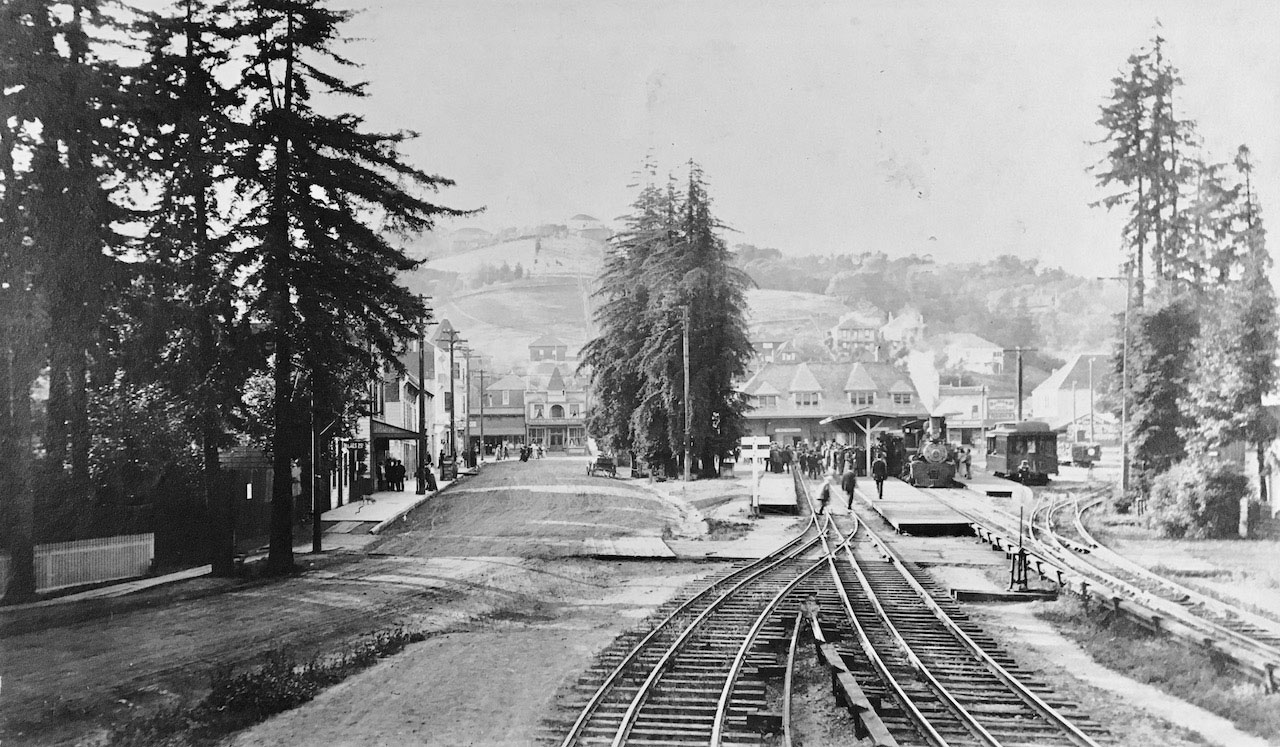

This photograph was taken more than 100 years ago, but for most Marin residents is instantly
recognizable as the downtown Mill Valley train station. There are scores of passengers queuing up
for the train with a few late arrivals sprinting across the tracks. The redwoods in the center of the
photograph still stand today separating the Depot Bookstore & Café parking lot from Miller
Avenue. This original downtown station was constructed in 1900 when Mill Valley was still called
Eastland; 26 years after the North Pacific Coast Railroad (NPCRR) had first laid narrow-gauge
tracks from Sausalito to San Rafael. Within a couple of years, trains were running all the way to
Duncan Mills in Sonoma County to carry north coast timber and dairy products back to San
Francisco. Passenger service to Cazadero in Sonoma County was added in 1886. The only Mill
Valley station in those earlier years was a junction stop near present-day Tamalpais High School.
As Mill Valley grew in population the spur line to downtown was added along with an
intermediate depot named Millwood. Visitors from around the Bay were also flocking to town to
ride the Mill Valley and Mount Tamalpais Scenic Railway to the top of the mountain. Nicknamed,
“The Crookedest Railroad in the World”, another line was soon completed to Muir Woods and the
locally owned and built railroad changed its name to the Mt. Tamalpais & Muir Woods Railroad.
Both companies used the downtown station seen in the photograph. In 1902, the NPCRR was sold
and became the North Shore Railroad (NSRR). Within a year the NSRR had converted the old
narrow-gauge lines to standard-gauge and added an electric "third rail" design (seen in the
photograph) for service from Sausalito to Fairfax and through to San Rafael. In 1907 the railroad
was reorganized in a Santa Fe/Southern Pacific partnership and renamed The Northwestern Pacific
Railroad.
The original downtown station was demolished and replaced in 1929 by the mission-revival
building that still stands on the site today. Less than 15 years later, as automobiles and buses
became the preferred mode of travel, commuter rail service throughout Marin was abandoned
bringing an end to Marin’s heyday of the “Iron Horse.”
(Originally appeared as History Watch article in the Marin Independent Journal)
For more background information see our online catalog!