
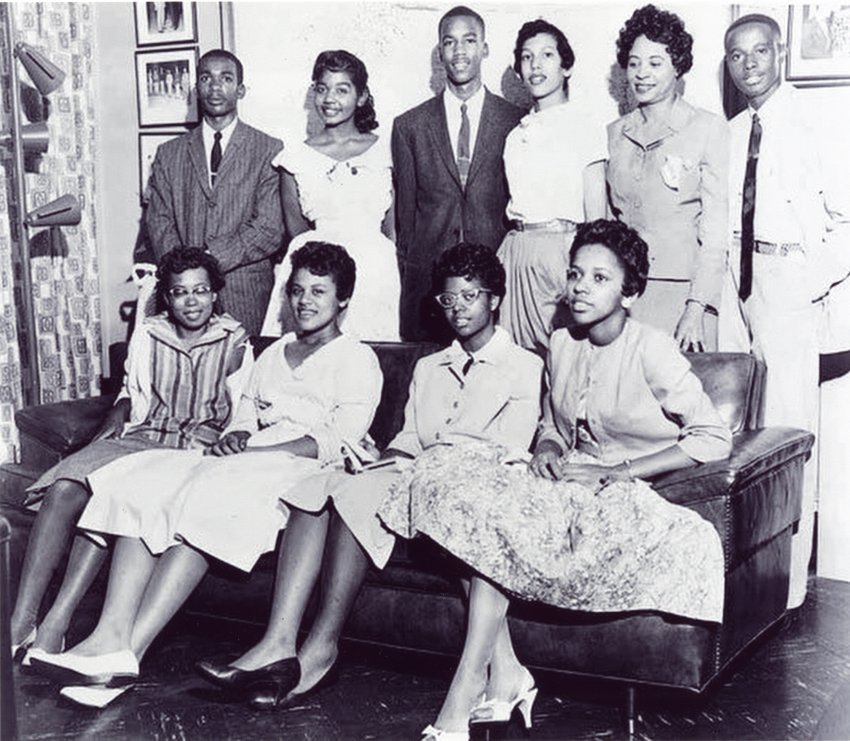

Photograph of the Little Rock Nine in 1957. Melba Pattillo Beals is seen standing second from left.
The centuries-old struggle for African- American Civil Rights has many watershed moments where individuals and groups have stepped forward to challenge racial inequality. In 1956, school integration in Little Rock, Arkansas, became the scene of that battle and Melba Beals was at the center of the fight. Melba, along with eight other teenagers applied to attend all-white Central High School. Despite incredible resistance which included lynching, beatings and daily harassment, the students made it through the year with the help of the 101st Airborne Division, dispatched by President Eisenhower in a history- making move challenging states’ rights.
The following year, after the Arkansas Governor closed all Little Rock high schools, the NAACP moved Melba to Santa Rosa, CA to continue her education and live with the white Quaker family of Dr. George and Carol McCabe. The McCabe’s became Melba’s second family and helped her enroll at S.F. State University the following year, where George McCabe taught. Melba eventually moved to San Francisco and completed her undergraduate degree. During that time, she met and married John Beals, a white soldier stationed in Sausalito and gave birth to her daughter, Kellie. Melba and John divorced a few years later. Melba attended Columbia University on a prestigious scholarship program in Journalism after which she moved back to the Bay Area and worked as the second African American news reporter for the KQED Newsroom program, for NBC affiliate, KRON-TV and as a reporter for People magazine.
In a recent interview, Dr. Beals spoke eloquently about “living in two different worlds” and the blessing of having two distinct families both of whom gave her the strength and determination to persevere through hardship and realize the goals she set for herself. She credits her grandmother, India, for teaching her important life lessons on love and forgiveness and her mother, Dr. Lois Pattillo, a teacher and one of the first African-American graduates at the University of Arkansas, for guiding and encouraging her to excel in academics. Melba praises the McCabe family for providing unconditional love and showing her, through their encouragement and their own causes, that she could accomplish anything she set out to do. George McCabe was one of the founders of Sonoma State University and Carol was a tireless advocate for many causes including bringing the first PBS station to Santa Rosa and helping form the Russian River Project to protect the Russian River.
In 1993, Melba adopted two twin boys, Matthew and Evan, and went on to earn her PhD from USF in International Multi-cultural Education. In 1999, she joined the Journalism Department at San Rafael’s Dominican University and worked tirelessly to expand opportunities for students and faculty of color. She also created a Communications Department to prepare students for production of television, radio and print news. Dr. Beals has written four books, Warriors Don’t Cry, White is a State of Mind, March Forward, Girl, and I Will Not Fear.
In discussing the recent Black Lives Matter movement, Dr. Beals compared the ongoing efforts to extend equality and dignity to all Americans as having to, “Plow that field, again and again; though the work is hard, and the plow is heavy.”
This article appeared in the Marin History Museum Bulletin, Summer 2020
The following year, after the Arkansas Governor closed all Little Rock high schools, the NAACP moved Melba to Santa Rosa, CA to continue her education and live with the white Quaker family of Dr. George and Carol McCabe. The McCabe’s became Melba’s second family and helped her enroll at S.F. State University the following year, where George McCabe taught. Melba eventually moved to San Francisco and completed her undergraduate degree. During that time, she met and married John Beals, a white soldier stationed in Sausalito and gave birth to her daughter, Kellie. Melba and John divorced a few years later. Melba attended Columbia University on a prestigious scholarship program in Journalism after which she moved back to the Bay Area and worked as the second African American news reporter for the KQED Newsroom program, for NBC affiliate, KRON-TV and as a reporter for People magazine.
In a recent interview, Dr. Beals spoke eloquently about “living in two different worlds” and the blessing of having two distinct families both of whom gave her the strength and determination to persevere through hardship and realize the goals she set for herself. She credits her grandmother, India, for teaching her important life lessons on love and forgiveness and her mother, Dr. Lois Pattillo, a teacher and one of the first African-American graduates at the University of Arkansas, for guiding and encouraging her to excel in academics. Melba praises the McCabe family for providing unconditional love and showing her, through their encouragement and their own causes, that she could accomplish anything she set out to do. George McCabe was one of the founders of Sonoma State University and Carol was a tireless advocate for many causes including bringing the first PBS station to Santa Rosa and helping form the Russian River Project to protect the Russian River.
In 1993, Melba adopted two twin boys, Matthew and Evan, and went on to earn her PhD from USF in International Multi-cultural Education. In 1999, she joined the Journalism Department at San Rafael’s Dominican University and worked tirelessly to expand opportunities for students and faculty of color. She also created a Communications Department to prepare students for production of television, radio and print news. Dr. Beals has written four books, Warriors Don’t Cry, White is a State of Mind, March Forward, Girl, and I Will Not Fear.
In discussing the recent Black Lives Matter movement, Dr. Beals compared the ongoing efforts to extend equality and dignity to all Americans as having to, “Plow that field, again and again; though the work is hard, and the plow is heavy.”
This article appeared in the Marin History Museum Bulletin, Summer 2020