
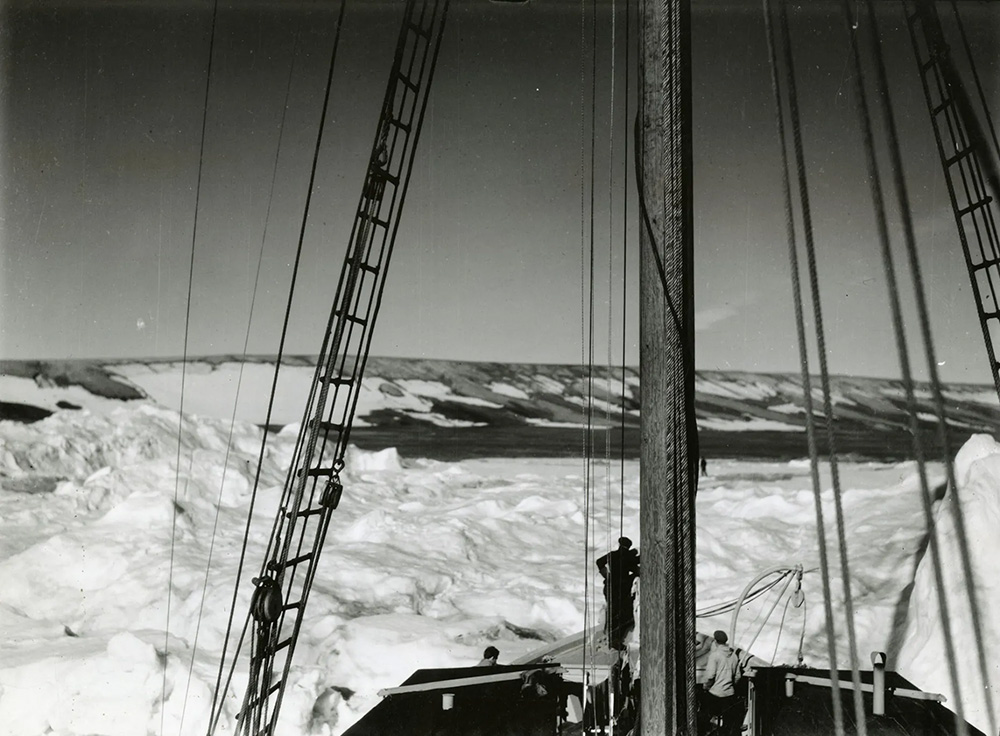

The S.S. Veslekari sails through packed ice in the Arctic in August 1938. (Louise A. Boyd/Courtesy of Marin History Museum)
The last time Greenland played a starring role in American foreign policy, the United States government sent a Marin millionaire on a secret mission.
In the years leading up to America’s entry into World War II, the Danish colony evolved from an Arctic backwater to strategic territory. It was well positioned for reporting weather data from the North Atlantic — information critical for attack plans and ship movements — and uncomfortably close to North America. Greenland was also the world’s only major source of cryolite, a mineral used in processing the aluminum needed for aircraft production.
So when Germany moved in to occupy Denmark in 1940, the War Department had to act fast to keep Axis powers from setting up bases in Greenland. And the only American who knew its remote east coast like the back of her hand lived in a mansion on Mission Avenue in San Rafael.
Marin history buffs know the story of Louise Arner Boyd, a Gold Rush heiress who first made headlines 100 years ago for hunting polar bears in the Arctic. Born in 1887 and raised in San Rafael as a debutante, Boyd grew up in the Northern California hills with her older brothers, becoming a crack shot and skilled rider. But she was also a consummate socialite who was presented to the King and Queen of England.
Though many remember Boyd as a philanthropist and know of her Arctic expeditions, few realize that the United States government considered her knowledge of Greenland so vital to national security that she played a clandestine role in securing the North Atlantic during WWII.
In the years leading up to America’s entry into World War II, the Danish colony evolved from an Arctic backwater to strategic territory. It was well positioned for reporting weather data from the North Atlantic — information critical for attack plans and ship movements — and uncomfortably close to North America. Greenland was also the world’s only major source of cryolite, a mineral used in processing the aluminum needed for aircraft production.
So when Germany moved in to occupy Denmark in 1940, the War Department had to act fast to keep Axis powers from setting up bases in Greenland. And the only American who knew its remote east coast like the back of her hand lived in a mansion on Mission Avenue in San Rafael.
Marin history buffs know the story of Louise Arner Boyd, a Gold Rush heiress who first made headlines 100 years ago for hunting polar bears in the Arctic. Born in 1887 and raised in San Rafael as a debutante, Boyd grew up in the Northern California hills with her older brothers, becoming a crack shot and skilled rider. But she was also a consummate socialite who was presented to the King and Queen of England.
Though many remember Boyd as a philanthropist and know of her Arctic expeditions, few realize that the United States government considered her knowledge of Greenland so vital to national security that she played a clandestine role in securing the North Atlantic during WWII.
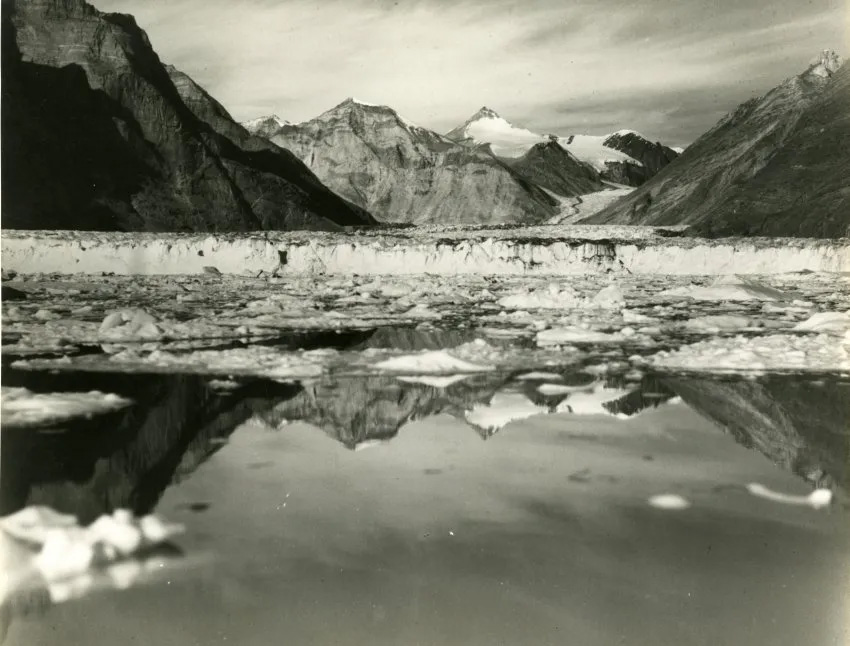
An image of the Nordenskiöld Glacier in East Greenland’s Franz Josef Fjord in July 1931.
(Louise A. Boyd/Courtesy of Marin History Museum)
A pioneering polar explorer
The idea that a girl of the late Victorian era could grow up to be a polar explorer was almost unbelievable. Boyd came of age during the days when women wearing “breeches” was odd enough to turn heads. Yet she always loved reading adventure tales, and polar exploration was front-page news of the day: American Robert Peary claimed the North Pole in 1909, and Norwegian Roald Amundsen reached the South Pole in 1913.
Boyd became the sole heir to her family’s fortune after her brothers tragically died from rheumatic fever as teens. After dutifully spending her youth running her father’s company and caring for her aging parents until they died, Boyd began to travel the world as a 30-something.
Boyd first traveled to the Arctic on a 1924 tourist expedition to the Svalbard Archipelago, lying halfway between Norway’s mainland and the North Pole. As the ship approached the islands, she stayed up all night to catch her first glimpse of Arctic ice at 6 a.m.
“I understood for the first time what an old seaman meant when he told me that once you had been to the Arctic and in the ice, you never could forget it and always wanted to go back,” Boyd recalled in a 1938 interview.
Once home, Boyd immediately began planning to finance and lead her own expedition to the Arctic. Though a famed English captain refused the job because she was a woman, Boyd successfully chartered the Hobby, a Norwegian sealer Amundsen himself had recently used, and spent the summer of 1926 documenting the topography of Franz Josef Land in the Russian Arctic.
Boyd served as photographer on the expedition, which required portage of heavy equipment over the ice. But she shot more than film. In fact, she shot six or seven of the 29 polar bears killed by her party during the first expedition. The crew marveled at her ability to hit her “favorite animal” from the deck of a rocking ship.
Though the folly of a socialite shooting bears put her name in the headlines, Boyd abandoned hunting for more serious scientific pursuits. She hired the Hobby again for a 1928 trip that ended up being a rescue operation. Upon arrival in Norway, Boyd learned that Europe’s top Arctic navigators had been rallied to search for Amundsen, whose plane had been lost in the region. Boyd offered her ship to join the hunt.
Her crew spent months crisscrossing 10,000 miles of sea, from the Svalbards to Greenland, in search of her hero. Though Amundsen was never found, the Norwegian king bestowed the Order of St. Olav, First Class, upon Boyd, the first foreign woman to receive the honor.
Boyd’s 1931 and 1933 expeditions hired a larger ship, the Veslekari, and aimed for the uncharted coasts of East Greenland. She brought along a large crew of scientists, including experts in botany, cartography, hydrology and radio operations. Boyd published a book on the area, producing the first-ever charts of the King Oscar and Franz Josef fjords, the world’s largest fjordic region. The Danes recognized her work by naming one area “Weisboydland,” or “Miss Boyd Land.”
Two more expeditions to Greenland followed in 1937 and 1938. Boyd’s 1937 voyage packed a sonic depth gauge, which mapped the sea floor and identified a submarine ridge that impacted currents in the area. Fair weather in 1938 allowed Boyd to travel to the northernmost point ever reached by an American and the Veslekari to attain the second-highest latitude ever reached by ship.
Boyd’s later voyages sailed under the flag of the American Geographical Society, though she always paid her own way. One voyage was estimated to cost $40,000 in the 1930s — and these costs may have contributed to her penniless status when she died in 1972.
The head of the American Geographical Society, Isaiah Bowman, was a notoriously cranky scholar with little patience for women. But Bowman recognized Boyd’s passion and took the time to teach her about photogrammetry, a mapping technique that involves taking 2D photos from many angles to provide a 3D effect. Her work was so impressive that the American Geographical Society awarded Boyd the Cullum Medal, a prestigious honor that both Amundsen and Peary had also received.
But when Boyd sought to publish her latest book with maps of Greenland’s east coast, the United States government stopped the presses. Her charts were too valuable to fall into enemy hands.
Boyd became the sole heir to her family’s fortune after her brothers tragically died from rheumatic fever as teens. After dutifully spending her youth running her father’s company and caring for her aging parents until they died, Boyd began to travel the world as a 30-something.
Boyd first traveled to the Arctic on a 1924 tourist expedition to the Svalbard Archipelago, lying halfway between Norway’s mainland and the North Pole. As the ship approached the islands, she stayed up all night to catch her first glimpse of Arctic ice at 6 a.m.
“I understood for the first time what an old seaman meant when he told me that once you had been to the Arctic and in the ice, you never could forget it and always wanted to go back,” Boyd recalled in a 1938 interview.
Once home, Boyd immediately began planning to finance and lead her own expedition to the Arctic. Though a famed English captain refused the job because she was a woman, Boyd successfully chartered the Hobby, a Norwegian sealer Amundsen himself had recently used, and spent the summer of 1926 documenting the topography of Franz Josef Land in the Russian Arctic.
Boyd served as photographer on the expedition, which required portage of heavy equipment over the ice. But she shot more than film. In fact, she shot six or seven of the 29 polar bears killed by her party during the first expedition. The crew marveled at her ability to hit her “favorite animal” from the deck of a rocking ship.
Though the folly of a socialite shooting bears put her name in the headlines, Boyd abandoned hunting for more serious scientific pursuits. She hired the Hobby again for a 1928 trip that ended up being a rescue operation. Upon arrival in Norway, Boyd learned that Europe’s top Arctic navigators had been rallied to search for Amundsen, whose plane had been lost in the region. Boyd offered her ship to join the hunt.
Her crew spent months crisscrossing 10,000 miles of sea, from the Svalbards to Greenland, in search of her hero. Though Amundsen was never found, the Norwegian king bestowed the Order of St. Olav, First Class, upon Boyd, the first foreign woman to receive the honor.
Boyd’s 1931 and 1933 expeditions hired a larger ship, the Veslekari, and aimed for the uncharted coasts of East Greenland. She brought along a large crew of scientists, including experts in botany, cartography, hydrology and radio operations. Boyd published a book on the area, producing the first-ever charts of the King Oscar and Franz Josef fjords, the world’s largest fjordic region. The Danes recognized her work by naming one area “Weisboydland,” or “Miss Boyd Land.”
Two more expeditions to Greenland followed in 1937 and 1938. Boyd’s 1937 voyage packed a sonic depth gauge, which mapped the sea floor and identified a submarine ridge that impacted currents in the area. Fair weather in 1938 allowed Boyd to travel to the northernmost point ever reached by an American and the Veslekari to attain the second-highest latitude ever reached by ship.
Boyd’s later voyages sailed under the flag of the American Geographical Society, though she always paid her own way. One voyage was estimated to cost $40,000 in the 1930s — and these costs may have contributed to her penniless status when she died in 1972.
The head of the American Geographical Society, Isaiah Bowman, was a notoriously cranky scholar with little patience for women. But Bowman recognized Boyd’s passion and took the time to teach her about photogrammetry, a mapping technique that involves taking 2D photos from many angles to provide a 3D effect. Her work was so impressive that the American Geographical Society awarded Boyd the Cullum Medal, a prestigious honor that both Amundsen and Peary had also received.
But when Boyd sought to publish her latest book with maps of Greenland’s east coast, the United States government stopped the presses. Her charts were too valuable to fall into enemy hands.
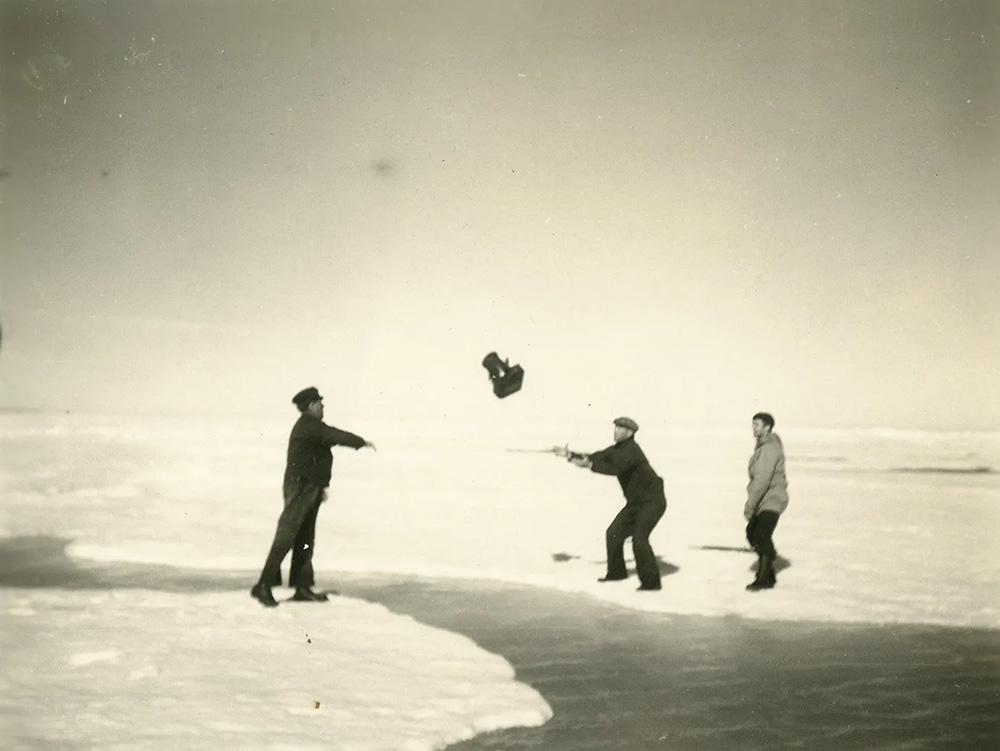
Crew members throw a large camera across open water between ice sheets in Greenland in July 1938.
(Louise A. Boyd/Courtesy of Marin History Museum)
A national asset
Uncle Sam tapped Boyd as a consultant on Greenland in preparation for WWII. Her final ocean voyage to its western coast and eastern Canada in 1941 was actually a secret mission to identify suitable locations for United States bases and provide key charts to the Coast Guard. Even her captain and crew did not know the true reason for their trip.
The publicized goal of Boyd’s 1941 mission involved studying magnetic radio phenomena for the National Bureau of Standards. Experts knew that polar communications would be critical during the war but needed a better understanding of why transmissions often failed in the region.
Boyd helped to resolve the radio issues and obtained the necessary charts. She earned a certificate of appreciation from the Department of the Army, honoring her patriotic service as a “contributor of geographic knowledge” and “highly beneficial to the cause of victory.”
The findings of Boyd’s radio studies were never published, but her book “The Coast of Northeast Greenland” was finally published in 1948. She made one final mission to the Arctic in 1967, flying over the North Pole and fulfilling a childhood dream.
In between expeditions and following her retirement from Arctic exploration, Boyd would return to San Rafael to continue her work as a philanthropist and socialite. She served on the board of the San Francisco Symphony, became an honorary member of the California Academy of Sciences and earned honorary degrees from the University of California at Berkeley and Mills College.
Despite making headlines during her prime polar exploration days, Boyd was never one for self-promotion. Perhaps that’s why she is not as well known today as many of the other groundbreaking adventurers of her day.
“I haven’t wanted to talk about myself, for I did not know when I started out that I could do the job,” Boyd said in a 1938 interview. “I had to learn first whether I was suited for leadership, particularly with a group of men and, second, whether I could contribute anything of value. I think I have produced something worthwhile, of which I can be proud, and as for the men, most of them go back with me each voyage. We get along fine.”
And the legacy of Boyd’s Arctic research continues. Her thousands of photographs and hours of film footage from expeditions a century ago are part of the National Archives and used by today’s climate scientists to understand how much the glacial ice pack has changed over the past century.
The eastern portion of her San Rafael estate — now the San Rafael Elks’ lodge — commemorates her older brothers and serves as Boyd Park and Boyd House, home of the Marin History Museum, where visitors can see Boyd’s Arctic snowshoes and wood-framed backpack for themselves.
Maryann Jones Thompson is a freelance journalist based in Marin County.
This article originally appeared in the Marin Independent Journal.
The publicized goal of Boyd’s 1941 mission involved studying magnetic radio phenomena for the National Bureau of Standards. Experts knew that polar communications would be critical during the war but needed a better understanding of why transmissions often failed in the region.
Boyd helped to resolve the radio issues and obtained the necessary charts. She earned a certificate of appreciation from the Department of the Army, honoring her patriotic service as a “contributor of geographic knowledge” and “highly beneficial to the cause of victory.”
The findings of Boyd’s radio studies were never published, but her book “The Coast of Northeast Greenland” was finally published in 1948. She made one final mission to the Arctic in 1967, flying over the North Pole and fulfilling a childhood dream.
In between expeditions and following her retirement from Arctic exploration, Boyd would return to San Rafael to continue her work as a philanthropist and socialite. She served on the board of the San Francisco Symphony, became an honorary member of the California Academy of Sciences and earned honorary degrees from the University of California at Berkeley and Mills College.
Despite making headlines during her prime polar exploration days, Boyd was never one for self-promotion. Perhaps that’s why she is not as well known today as many of the other groundbreaking adventurers of her day.
“I haven’t wanted to talk about myself, for I did not know when I started out that I could do the job,” Boyd said in a 1938 interview. “I had to learn first whether I was suited for leadership, particularly with a group of men and, second, whether I could contribute anything of value. I think I have produced something worthwhile, of which I can be proud, and as for the men, most of them go back with me each voyage. We get along fine.”
And the legacy of Boyd’s Arctic research continues. Her thousands of photographs and hours of film footage from expeditions a century ago are part of the National Archives and used by today’s climate scientists to understand how much the glacial ice pack has changed over the past century.
The eastern portion of her San Rafael estate — now the San Rafael Elks’ lodge — commemorates her older brothers and serves as Boyd Park and Boyd House, home of the Marin History Museum, where visitors can see Boyd’s Arctic snowshoes and wood-framed backpack for themselves.
Maryann Jones Thompson is a freelance journalist based in Marin County.
This article originally appeared in the Marin Independent Journal.