
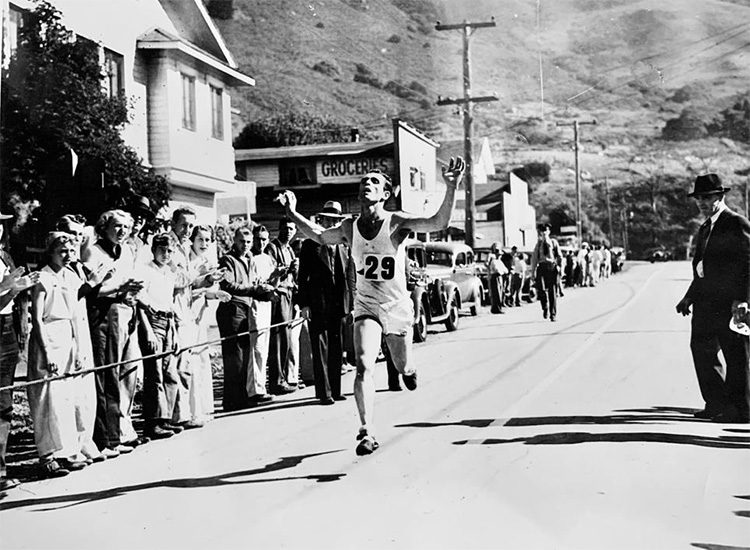

And the winner is… number 29, Paul Chirone of San Anselmo! More on Paul a little later. The world famous Dipsea Race, first run from downtown Mill Valley over Mt. Tamalpais to Stinson Beach in 1905, was the first organized trail race of its kind and has been run nearly every year since. The 115-year-old Dipsea race had its origins in a bet made by two San Francisco Olympic Club members, Alfons Coney and Charles Boas soon after the Dipsea Inn had opened on the sand bar that protects Bolinas Lagoon. The Inn was owned by William Kent and Sydney Cushing and was to be a popular destination for vacationers to Willow Camp, the early name for Stinson Beach. Coney and Boas, both avid hikers and frequent guests at the Inn raced against each other from downtown Mill Valley to the Dipsea Inn with Coney being declared the winner. The following year, Olympic Club members organized the first official Dipsea Race with over 100 contestants competing.
The race began at the Mill Valley train depot and climbed 7.4 miles over the mountain ending with a long, tiring run on the sand spit near the Inn. Many runners were given head-starts or handicaps based on their individual times in other races while the ‘scratch’ runners were the more experienced, professional racers. A 17-year-old, J.G. Hassard of Oakland High School crossed the finish line first in a driving rain, benefitting from a 10-minute head start. The fastest time, one hour and four minutes was run by C. Connolly who arrived just two minutes after Hassard. By 1907, the grueling last dash over the sand was removed from the course and contestants finished the race on the main road through Willow Camp.
The race was exclusively male in its early years but in 1918 a Dipsea ‘Hike’ was organized for women by Olympic Club member and women’s sports advocate, George James. The women’s Dipsea race was called a hike rather than a race to placate the Amateur Athletic Union which frowned on women competing in most sports. The inaugural winner was 19-year-old Edith Hickman who finished in one hour and eighteen minutes, six full minutes ahead of her nearest competitor. The ‘Hike’ grew in popularity; there were over 600 contestants in its third year, and even outdistanced the men’s race in interest with thousands of spectators lining the finish line. Unfortunately, after the 1922 race, patronizing chauvinism won the day and the event was cancelled as, “…local churches and physicians were objecting to the competitors’ fashion (‘hiking costumes’) and ‘undue stress on women’s bodies’ with health concerns that the competitors were compromising their reproductive systems.” It wasn’t until the 1950s that women began running the race again and not until 1971 that they were allowed to be official entrants. Since that time, contestants of all ages and gender have run the race and the age-handicapping system has produced both male and female first place finishers from eight-years-old to seventy.
And now, back to Paul Chirone. Paul was a 23-year-old who had run for the Tamalpais High track team without much fanfare. He had finished 25th out of thirty-five runners in the 1936 Dipsea. But on the night before the 1937 race, Chirone met Norman Bright, an Olympic Trials runner and recent winner of the Cross City run (now the Bay to Breakers) and picked up some tips about the course and how to run it. Although Norman Bright would finish with the best time, forty-seven minutes, twenty-two seconds, a race record for 33 years, Paul, benefitting from a 6-minute handicap, crossed the finish line first by just sixteen seconds and became the first Marin resident to win the Dipsea. After his death in 1990, a plaque was placed outside Town Hall in San Anselmo that reads, “Paul Chirone, 1937 Dipsea Champion. If You Can’t Bring Happiness to Yourself, Bring It To Others.”
I wish to acknowledge Dave Albee and The Dipsea Race Committee for their assistance and Barry Spitz, Dipsea historian and author of “Dipsea: The Greatest Race” who identified the runner and year of the photograph.
(Originally appeared as History Watch article in the Marin Independent Journal)
For more background information see our online catalog!