
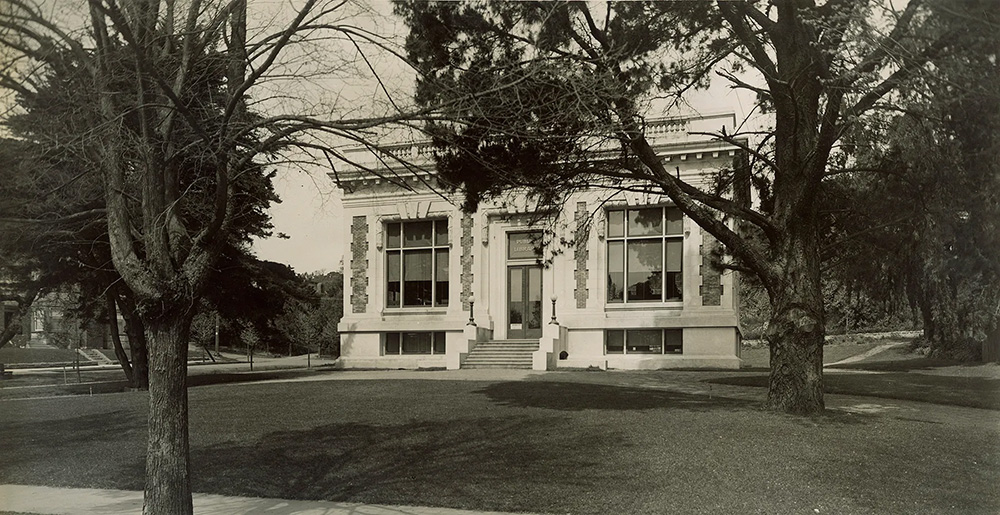

San Rafael’s Carnegie library (MHM Collection)
It’s no secret: America’s libraries have been under siege for many years now, assaulted by budget cuts, book bannings, DEI program removals and even threats and violence against librarians. In response, libraries should be all the more cherished, protected and celebrated.
Marin County has been blessed with a vibrant library culture. The MARINet consortium connects two college libraries (Dominican University of California and College of Marin) and public libraries in Marin in a system of shared catalogs, resources and borrowing privileges. Recently, several of those libraries have modernized their facilities, but it might be worth remembering the history that launched Marin’s libraries in the first place.
Two public libraries had their origins in 1887. Sausalito began a privately funded reading room that year, which became its first public library in 1907. San Rafael began its own reading room, which became its public library in 1909. The Mill Valley, San Anselmo and Larkspur libraries all started between 1911 and 1915, and the Marin County Free Library was launched in 1927.
Carnegie libraries
Among these early libraries, three stand out. The original library buildings in San Rafael, Mill Valley and San Anselmo were all funded by the Carnegie Corporation of New York, the charitable foundation established by 19th-century industrial magnate Andrew Carnegie.
In 1848, when Carnegie was 12 years old, he emigrated from Scotland to Allegheny — now Pittsburgh — Pennsylvania. Upon arrival, he was given access to the private library of a local businessman, which Carnegie regarded as a life-changing experience. Valuing books, Carnegie made a special commitment to building “libraries for the public good” after becoming a multimillionaire through his expansion of the American steel industry.
In 1881, Carnegie funded his first library, which opened in his birthplace of Dunfermline, Scotland, in 1883. In 1886, he endowed his first U.S. library in Allegheny, although it actually opened in 1890, a year after his second American library, in Braddock, Pennsylvania, the site of one of his steel mills.
his began the process of funding more than 2,500 library buildings worldwide, 1,681 of them in the U.S., at a cost of $56 million. Women’s clubs in the U.S. were instrumental in securing Carnegie library funding. By 1929, when the last one was built, almost half of the libraries in America were Carnegie libraries.
The Carnegie library interiors broke from the typical European design, shunning high shelves accessible only by ladders and hidden niches and galleries. They featured high ceilings and large windows placed well above the floors. Separate reading rooms were provided for adults and children as well as a lecture room. Carnegie libraries also pioneered open stacks (shelves) that were directly accessible to the public. Library furniture and external architecture weren’t standardized. Even so, Carnegie libraries usually featured dramatic and elegant exteriors.
Carnegie controversy
Although they made an important contribution to the development of U.S. libraries, the Carnegie institutions weren’t without controversy. While the Carnegie Corporation later began funding worthy projects at selected libraries as well as the endowment that created the American Library Association, grants to local towns were limited to providing the cost of creating the library buildings. Funding would be secured only if towns made a long-term commitment to maintaining and financing the staff, books and other materials the libraries would contain. This produced a dilemma for towns that welcomed new facilities but worried about raising the resources necessary for running them.
More seriously, Carnegie made his fortune on the backs of exploited workers, who suffered from poor wages, nonexistent benefits and dangerous and unhealthy working conditions at his mills. Carnegie was fiercely anti-union, often unleashing company guards and hired thugs to violently break strikes and other labor actions, including in the Homestead massacre in 1892. Mark Twain claimed that Carnegie’s library philanthropy was a kind of social control, created to improve his image in the face of criticism.
When it was suggested that some of Carnegie’s millions should have instead been used to pull his workers out of poverty, he claimed that “if I had raised your wages, you would have spent that money by buying a better cut of meat or more drink for your dinner. But what you needed, though you didn’t know it, was my libraries and concert halls.”
Carnegie claimed libraries would help alleviate poverty, despite his own role in creating it. And although the Carnegie Corporation funded the New York Public Library’s 1926 purchase of a groundbreaking archive of Black life, history and culture, it nevertheless also created and perpetuated segregated libraries in the South.
Despite these criticisms, the long-term positive impact of the Carnegie libraries can hardly be disputed, and Marin County has reaped some of those benefits. The three Carnegie libraries established in Marin were an inspiration for the impressive library system that we enjoy in this county today.
San Rafael Carnegie library
In San Rafael, the Women’s Christian Temperance Union decided to establish a coffee and reading room in April 1887, holding a flower festival and musical to finance the project. In June, the room opened in a rented building on Fourth Street with 60 members. In April 1890, San Rafael accepted guardianship of the library, which included furniture, a small fund and more than 1,000 books, and the town levied a library tax for future support. In 1898, San Rafael residents approved a bond measure to create a new high school, one of whose selling points was that the building would also house the town library.
The library occupied the high school from 1899 until 1904, when local resident Judge William W. Morrow — a friend of Carnegie and a Carnegie Institution trustee — approached the magnate about a library for San Rafael. At a lunch at New York’s Waldorf Astoria, Carnegie offered $25,000 for a library building. By 1906, a fundraising campaign had raised the $6,500 needed to purchase the library site, but the devastating earthquake that year delayed all construction projects while San Francisco was being rebuilt.
The library was finally completed for its opening in January 1909. The elegant building was designed in the Classical Revival style (type A) by the Reid Brothers, a top San Francisco architectural firm that also created the Fairmont hotel. Located at 1100 E St., the library was built by the Hoyt Brothers of Santa Rosa. May Cooper was the first head librarian.
By the late 1950s, San Rafael had outgrown its library. A 6,000-square-foot addition was placed on the north facade, which more than doubled the library’s size in 1960. In the mid-1970s, the library was again plagued by inadequate space despite additional repairs and construction in 1992 (earthquake retrofitting), 2008 (air conditioning and insulated windows) and 2024 (plumbing and electrical).
Finally solving the library’s space problem required local funding, which is now being used to create a new library and community center at Albert Park. Opening in 1909 with only 7,000 volumes, the original Carnegie building will remain in use, but it has inspired so much more: 500,000 books, computers, databases, streaming platforms, language learning apps and a celebration of community. As library director Catherine Quffa has observed, the library has become “a place of connection, discovery and wonder.”
Mill Valley Carnegie library
In Mill Valley, several reading rooms had emerged by 1908, but town growth prompted a demand for additional services. A bond measure for $50,000 was approved, with $2,500 earmarked to purchase a property for the newly established public library. Land was purchased in 1909 on Lovell Avenue at Madrona Street and the Fireman’s Hall temporarily housed the initial library of 750 books donated by the Outdoor Art Club reading room. A $10,000 grant from the Carnegie Corporation was secured to construct the building, which was designed in the Classical Revival style (type C) by the architect C.H. Russell and built by the Robert Tros Co. It opened in July 1911 with Lillian Gardner as the first head librarian.
By 1920, the book collection had grown to 4,388 volumes and then to 6,000 volumes by 1924. Concerns about additional space emerged in the 1930s, but they weren’t made a priority during the economic hard times of the Depression. The library received phone service for the first time in 1939, by which time its collection held 9,000 books. Access and space problems continued through the 1940s, with holdings exceeding 14,000 books, an annual circulation of 48,000 and 2,300 card-holding library patrons.
With the library still blossoming by the early 1960s, including 37,000 books and an annual circulation of 153,454, serious momentum finally emerged to construct a new library building. An Old Mill Park site was chosen for the facility in 1963, groundbreaking began in 1965 and the new library opened in 1966. That same year, the old Carnegie library building at 52 Lovell Ave. was sold to a private party for $16,000. It was subsequently resold and became both a residence and studio, with its brick facade and classical look almost completely hidden by vines and tall shrubs.
The new library building won an American Institute of Architects award for excellence in 1968. In 1978, it joined an automated circulation system with the Marin County libraries, and the founding of the Mill Valley Historical Society led to the addition of a History Room in 1979. In the early 1990s, plans were developed to expand the building to accommodate its 120,000-volume collection and growing technology needs. The library joined the MARINet consortium in 1994, and the expansion, including a new addition, was completed in 1998. Over the past 25 years, the Mill Valley Public Library has become a cherished community resource while continuing to adapt to the rapid growth of information on the internet and through new technologies.
San Anselmo Carnegie library
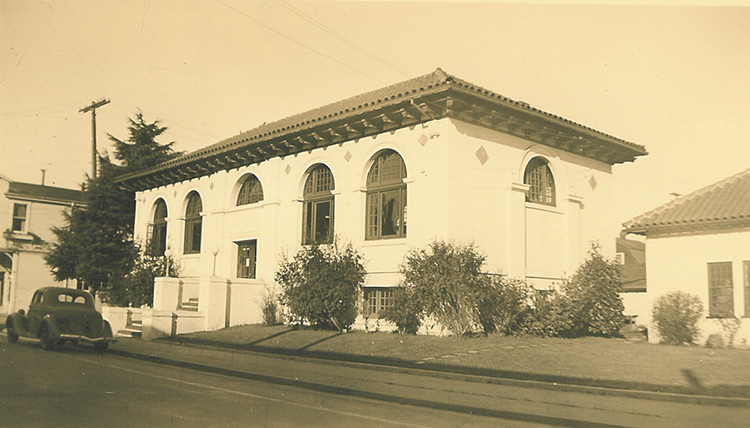
San Anselmo's Carnegie library in 1935. (Courtesy of San Anselmo Historical Museum)
In San Anselmo, the Women’s Improvement Club launched an initiative to create a library in 1912. With the help of Judge William W. Morrow, the town secured a $10,000 building grant from the Carnegie Corporation in 1914. Designed in the Mission/Spanish Colonial Revival style, featuring a red tile roof, decorative tile and arched windows, by architect W. Garden Mitchell and built by the Fred Fields company, the San Anselmo Public Library opened in 1915 at 110 Tunstead Ave. It’s connected to the adjacent Town Hall by a wisteria-covered arbor reproducing the library’s carved rafters in the Old California style. Bessie Wise was selected as the first head librarian.
In the early 1940s, the library began coping with flooding from the nearby San Anselmo Creek and the reduced building hours required to respect the evening World War II blackouts. In 1960, the library was remodeled and transformed into a square from its original rectangular shape. Friends of the San Anselmo Library was formed in 1975 to improve library services. Fears of flooding were finally realized in 1982, when 5 feet of water and mud destroyed 4,000 books in the basement. Volunteers worked to dry out some salvageable books and magazines. In 1995, the building underwent earthquake retrofitting, but flooding remained a problem, with more damage caused in 2005.
Despite the challenges, the San Anselmo Public Library continues meeting the needs of its diverse community for “lifelong learning, cultural enrichment, and intellectual stimulation.” With Mill Valley’s old Carnegie library decommissioned and San Rafael’s Carnegie building soon to be relegated to a backup status, San Anselmo’s Carnegie facility may be the last true survivor.
Legacy
In the years since the last Carnegie library, built in 1929, the Carnegie Corporation has funded dozens of progressive programs to promote democracy, education and international peace. This has helped to erase the stigma attached to the original Carnegie philanthropies stemming from the magnate’s labor policies. Today, the Carnegie Foundation no longer builds libraries but continues to support public libraries and deserves credit for inspiring the development of libraries across the nation.
Many original Carnegie library buildings remain highly treasured for their architectural styles. Although a few have been torn down, others have been repurposed as museums, restaurants and offices, while hundreds of others still survive as libraries or community reading centers.
Robert Elias is emeritus professor of Politics at the University of San Francisco, a Marin History Museum volunteer, and editor of the Mill Valley Historical Society Review.