
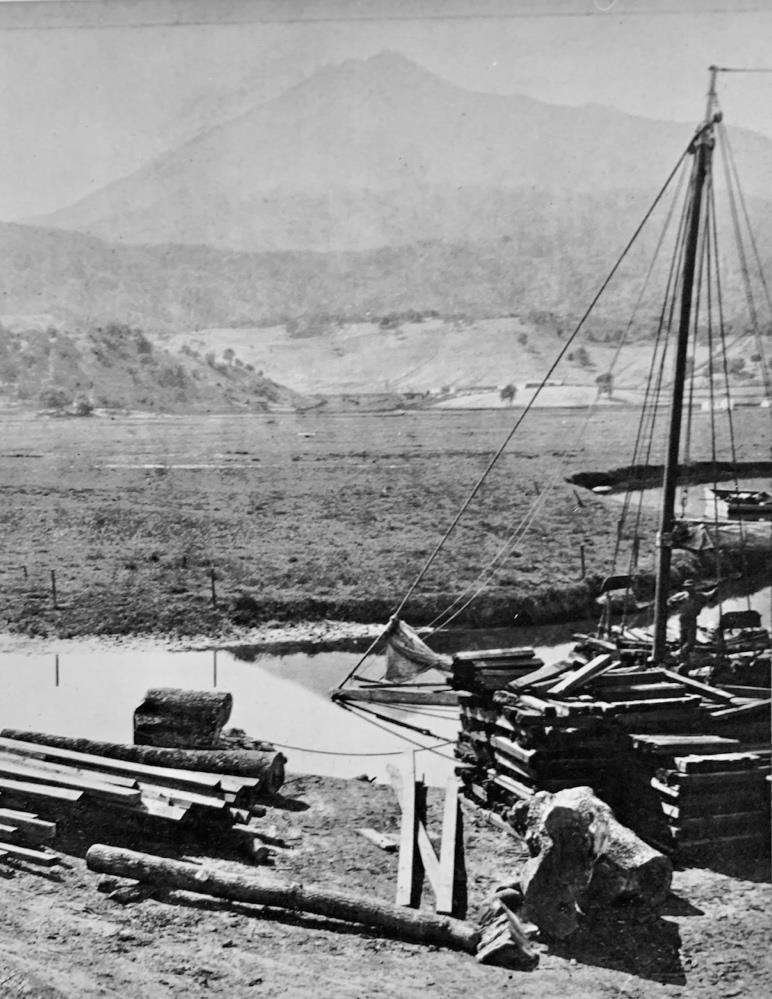

Traveling today through the tree-lined lanes of Ross and Kentfield one might be surprised to learn that the area was once home to an important Marin shipping hub. This early 1865 photograph shows what was then known as Ross Landing with a load of timber ready to be loaded onto a sloop bound for San Francisco. Before California became a state, the entire area running from Point San Quentin through San Rafael, Larkspur and much of Ross Valley was part of the Rancho Punta de Quentin land grant. It had been given to Captain Juan Cooper, who sold it in 1850 to Benjamin Buckelew for $50,000 in gold coin. Buckelew, who had a San Francisco jewelry shop that manufactured gold scales for miners also owned The Californian, San Francisco’s first newspaper. Buckelew continued operating the logging operations established by Cooper and sold 20 acres at the point in 1852 to the California legislature to build San Quentin prison.
It was at this time that James Ross entered the picture. Mr. Ross, a Scot, had emigrated to Australia before moving to San Francisco at the beginning of the Gold Rush. He made a fortune in the wholesale liquor business and brought his wife, Annie, and their three children over from Australia. In 1857, looking for a new business adventure and wanting to relocate his family to the pastoral splendor of Marin, Ross purchased the entire land grant area from Buckelew for the same $50,000 price and moved his family into the Buckelew home. James capitalized on the growing market for timber in San Francisco by establishing
Ross Landing near what is today Kentfield Corners. The Corte Madera Creek was navigable at that time for small sloops and schooners and Ross’ shipping business grew and prospered. He owned two sloops, cut his own timber and shipped lumber for other Marin sawmills. He also owned a steam sawmill at Point San Quentin and a stable of horses. James died young at the age of 50 in 1862, but his son James Jr. and his wife Annie continued running the family’s businesses through the decade. According to an 1865 Marin Journal article, a number of other businesses were established at ‘the Landing’ including a hotel, two stores, saloons, a blacksmith shop, and a brickyard. In 1866, a dance and ball was given there to benefit a new school attended by local leading families from San Rafael, San Quentin, Novato and Lagunitas.
In 1870, Annie Ross sold most of the family’s land except for the 300 acres around their home that would eventually become the Town of Ross. Her daughter, also named Annie, married George Austin Worn and the couple built a large home they called “Sunnyside” and planted extensive gardens on the site that we know today as The Marin Art & Garden Center. By the late 1870’s the Corte Madera Creek had begun silting up and ‘the Landing’ was no longer a viable transportation hub, especially with competition from the recently opened North Pacific Coast Railroad. Ross Landing evolved over the next few decades into an upscale, residential neighborhood for families wanting to relocate from San Francisco and it’s shipping and transportation industries passed into history.
(Originally appeared as History Watch article in the Marin Independent Journal)
For more background information see our online catalog!