

Even today, as one walks, bikes or drives through Larkspur, there is a look and feeling of small-town America that has been carefully preserved. The area was originally hunting and gathering grounds for the local Miwok inhabitants. Their village site was recently unearthed when the abandoned plant nursery on Doherty Drive across from Hall Middle School was removed for the building of homes. The excavated site contained 600 human burials, shells, tools, musical instruments, weapons, and the bones of grizzly bears, otters, deer and condors. The Miwok lost their land, first to the Mexican Californios, and subsequently the American settlers who followed the ‘rush’ for gold and the establishment of the State in 1850.
In the 1840’s, Irishman John Reed, was given a land grant by the Mexican Governor called Rancho Corte Madera del Presidio that included present-day Larkspur. The area was vigorously logged to supply lumber to the Presidio in San Francisco. Two sawmills operated in what is now Larkspur and barges floating down Corte Madera Creek shipped the timber across the Bay. Eventually, farming and ranching became the region's principal industries. There were a few homes in the area but no real town. In 1874 the North Pacific Coast Railroad laid tracks north from Sausalito to Cazadero in Sonoma County following the
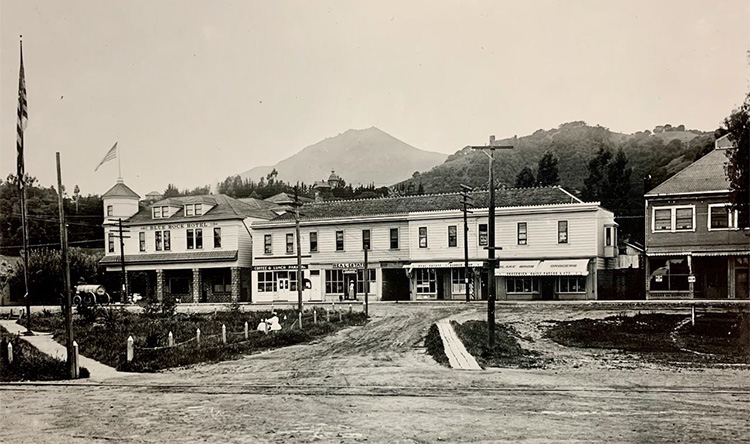
old county road, part of which is present-day Magnolia Blvd. A railway station was built in what would become Larkspur spurring growth in the area. The photograph is taken from the entrance to that station.
In 1886, C.W. Wright and his American Land and Trust Company purchased much of present-day Larkspur, subdivided the land and piped in water from a Baltimore Canyon. According to legend, Wright's wife, Georgiana, named the town Larkspur, mistaking the abundant, local lupine flower for larkspur. Wright laid out the town in 1887 and the first post office opened in 1891. Larkspur became a popular weekend destination where San Franciscans could come to fish, hunt and escape the summer fog. Wright built the Hotel Larkspur in 1891 to accommodate the many summer guests and operated a saltwater bathhouse across the street from the hotel that took advantage of the then free-flowing slough to the bay. In 1910, Serafino Marelli and William Stringa who owned a tavern in town bought Wright’s Hotel, refurbished and enlarged it, and changed the name to the Blue Rock Hotel, seen on the corner in the photograph.
The large building to the north of the hotel was owned by Richard & Bessie Lynch who replaced their small grocery store with the large, long, two-story structure. ‘Lynch Hall’ housed retail shops on the lower floor including a cafe, two real estate offices, the post office and the Blake Brothers Grocery. The entire second story was a large room that served as a general-purpose meeting hall and auditorium for the town. The last building partially seen on the rights was the Goerl building, built in 1891 by Fritz Goerl, a prosperous Bavarian brewer in San Rafael. It also had commercial businesses on the first floor and residences on the upper floor. For a few years it was the home to the Larkspur Drug Store; whose proprietress was a woman pharmacist named Evans Montgomery.
Thank you to the Larkspur Heritage Preservation Board’s Larkspur Past and Present: A History and Walking Guide.
(Originally appeared as History Watch article in the Marin Independent Journal)